background image

Learn about-


Boxtop


Revision 2.15

18th October 2011


Prefer paper?

pdf logo

Click to download this complete module in PDF format.

Valid XHTML 1.0 Transitional

Maths Help

Want some help with electronics math? Download our helpful booklet with tips for buying and using a scientific calculator and for sorting out all those electronics values. Invaluable help for the questions at the end of this unit!

Maths Tips

Step by Step logo

Module 2.5

Capacitor Quiz

What you should know.

  • After studying Module 2, you should:
  •   • Be able to Recognise common capacitor types and circuit symbols
  •   • Be able to describe charge and discharge in capacitors
  •   • Be able to describe dielectric strength and capacitance, and relate capacitance to charge.
  •   • Be able to use appropriate units of capacitance, and to calculate capacitance in series and parallel capacitor networks.

Try our quiz, based on the information you can find in Module 2. Hopefully it'll be a breeze. Submit your answers but don't be disappointed if you get answers wrong. Just follow the hints to find the right answer and learn about capacitors as you go.

1.

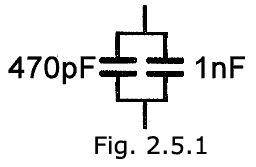
What is the approximate total capacitance of this parallel circuit? Parallel capacitors
  • a) 320pF
  • b) 147pF
  • c) 3.2nF
  • d) 1.47nF

2.

What is the approximate total capacitance of this series circuit? Capacitors in seriesl
  • a) 1.6nF
  • b) 576pF
  • c) 14.4pF
  • d) 12pF

3.

When might it be necessary to use a 2 µF polyester capacitor rather than a 2 µF electrolytic capacitor?
  • a) When High Voltages are present
  • b) When the capacitor passes AC
  • c) In low temperature conditions
  • d) When small size is the most important factor

4.

When a DC voltage is applied to a capacitor in its uncharged state:-
  • a) The capacitor voltage will be maximum but fall after a short time
  • b) The voltage will gradually rise at the same rate as the applied current
  • c) Maximum current will flow immediately
  • d) Maximum current will flow until the capacitor is fully charged

5.

As a capacitor charges
  • a) Electrons gather on the negative plate and displace electrons from the positive plate.
  • b) Electrons flow across the dielectric layer until the capacitor is fully charged
  • c) Electrons gather on the positive plate displacing electrons from the negative plate.
  • d) Current only flows through the capacitor for a short time.

6.

What type of capacitor does the symbol shown (right) represent? Example 6
  • a) A preset capacitor
  • b) An electrolytic capacitor
  • c) A variable capacitor
  • d) A ganged capacitor

7.

Calculate the value of capacitance needed to store 1 µC of charge at 10V
  • a) 10 µF
  • b) 1nF
  • c) 100nF
  • d) 10nF

8.

If a voltage is applied across the capacitor network shown, which individual capacitor has the largest voltage across it?


Example 8
  • a) C1
  • b) C2
  • c) C3
  • d) C4

9.

What is the approximate total capacitance of the network shown?Example 9
  • a) 13.05nF
  • b) 1.01uF
  • c) 391pF
  • d) 2.3nF

10.

Capacitance is directly proportional to:
  • a) The distance between the plates
  • b) The area of the plates
  • c) The dielectric strength
  • d) The charge multiplied by the applied voltage