


Google Ads
Module 3.0
Inductors

- Section 3.1 Electromagnetic Induction.
- • Magnetic Fields around Conductors.
- • The Solenoid.
- Section 3.2 Inductance & Back e.m.f.
- • The Unit of Inductance.
- • Factors affecting Inductance.
- • Voltage and e.m.f.
- • Back e.m.f.
- • Self Induction.
- Section 3.3 Practical Inductors.
- • The Solenoid.
- • Typical uses for inductors.
- • Inductor schematic symbols.
- Section 3.4 Inductor Colour Codes.
- • 4 Band EIA Inductor codes.
- • 5 Band Military Specification (Mil Spec) Inductor Codes.
- • Surface Mount Device(SMD) Inductor Codes.
- Section 3.5 Inductors Quiz.
Introduction
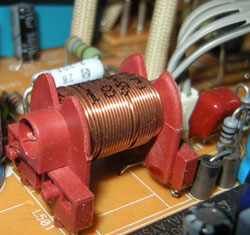
Inductors are components that are simple in their construction, consisting of coils of insulated copper wire wound around a former that will have some type of core at its centre. This core might be a metal such as iron that can be easily magnetised; or in high frequency inductors, it will more likely to be just air.
Inductors depend for their action on the magnetic field that is present around any conductor when it is carrying a current. If the wire coil is wound around a core made of a material that is easily magnetised, such as iron, then the magnetic field around the coil is concentrated within the core; this greatly increases the efficiency of the inductor.
Inductors in AC Circuits.
Inductors are extensively used in alternating current (AC) applications such as radio, TV and communications equipment, and in these systems, how inductors react to AC signals of different frequencies is very useful.
Chokes.
Another name used for an inductor is a "Choke". Inductors, being just coils of copper wire, will allow DC to pass easily, but when AC is applied, inductors create an opposition to current flow that increases, as the frequency of the alternating current increases. Therefore AC is prevented from flowing or is "Choked off" while DC is allowed to pass. This effect is used in power supply circuits where the public AC mains (line) supply has to be converted to a DC supply suitable for powering electronic circuits.
Energy Storage in a DC Circuit.
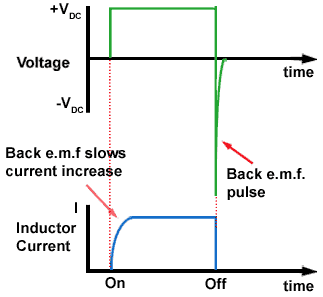
Fig. 3.0.1 Back e.m.f in an Inductor.
When a DC voltage is connected across an inductor, a current is made to flow through the inductor. As this current increases at switch on, an increasing magnetic field is created around the coils of wire. The electrical energy used in creating the magnetic field is therefore being stored as magnetic energy. Also when the energy in a magnetic field is changing, this will induce a voltage into those same coils that are setting up the magnetic field.
However the induced voltage, called an 'electromagnetic force of self induction' will be in the opposite polarity to the applied voltage that is setting up the magnetic field; therefore this induced e.m.f. is also commonly called a 'back e.m.f.' and its effect is to slow down the otherwise rapid change of current that takes place at switch on.
As the current through the inductor builds up, the rate of change of current has reduced, due to the back emf, and so has the back emf due to the reduced rate of change of the current. The electrical energy applied to the inductor has now been converted into magnetic energy and is stored in the magnetic field set up around the inductor.
If the voltage applied to the inductor is now switched off, the energy stored in the magnetic field is released back into the coils of the inductor, this time there is no opposing supply voltage applied so the entire magnetic field collapses instantly, and the stored energy, now in the form of a voltage across the inductor, but with opposite polarity to the original applied voltage.
This voltage will however now be much larger than the original supply voltage; this is because the amplitude of a voltage induced into a conductor is proportional to (among other factors) the rate of change of the magnetic field. At switch on, because there were two opposing voltages changing, the supply increasing and the back e.m.f. decreasing, the rate of change was slowed down. However at switch off there is no supply voltage so the magnetic field collapses extremely quickly causing a very rapid rate of change and therefore producing a very large voltage pulse.
This pulse can be tens, hundred or thousands of volts in amplitude, which can be very useful, e.g. in producing an ignition spark in a petrol engine, or very dangerous e.g. not good to touch! It can also very easily destroy other components such as semiconductors, and can be a source of serious radio interference.
Learn more about back e.m.f. here.
Inductors of many types.
The physical size of inductors varies greatly, depending on the power being handled, and on the frequency of the AC being used; from huge power transformers in power stations and the electricity supply grid, to tiny inductors in radio equipment consisting of a few turns of wire and only a few millimetres across.