background image

Learn about-


Boxtop


Revision 2.15

18th October 2011


Prefer paper?

pdf logo

Click to download this complete module in PDF format.

Search with

Valid XHTML 1.0 Transitional

Maths Help

Want some help with electronics math? Download our helpful booklet with tips for buying and using a scientific calculator and for sorting out all those electronics values. Invaluable help for the questions at the end of this unit!

Maths Tips

Step by Step logo

Module 7.4

Impedance Quiz

What you should know.

  • After studying Module 7, you should:
  •   • Be able to construct an impedance triangle for inductive and capacitive circuits.
  •   • Be able to calculate impedance in capacitive and inductive circuits using the impedance triangle.
  •   • Understand the necessity for impedance matching.
  •   • Be able to describe the effects of impedance on amplifier gain.
  •   • Be able to describe practical methods of measuring input and output impedance in amplifiers.

Try our quiz, based on the information you can find in Module 7. Some questions will also require a knowledge of associated modules 5 and 6. Submit your answers and see how many you get right, but don't be disappointed if you get answers wrong. Just follow the hints to find the right answer and learn about Impedance as well as revising Reactance and AC Circuits as you go.

1.
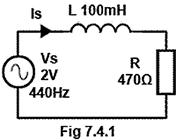
Fig 7.4.1With reference to Fig 7.4.1, what is the reactance XL of inductor L?
  • a) 545.25Ω
  • b) 276.47Ω
  • c) 3.67Ω
  • d) 360Ω

2.

With reference to Fig 7.4.1, what is the Circuit Impedance Z?
  • a) 545.28Ω
  • b) 221.20kΩ
  • c) 61MΩ
  • d) 276.52Ω

3.

With reference to Fig 7.4.1, what is the Supply Current IS?
  • a) 3.67mA
  • b) 36µA
  • c) 4.2mA
  • d) 373mA

4.

With reference to Fig 7.4.1, what is the voltage (VR) across the resistor R?
  • a) 2V
  • b) 0.54V
  • c) 1.61V
  • d) 1.72V

5.

Fig 7.4.4With reference to Fig 7.4.4, Which of the formulae is correct for finding the value of Z in a LCR circuit?
  • a) Formula a
  • b) Formula b
  • c) Formula c
  • d) Formula d

6.

Fig 7.4.2With reference to Fig 7.4.2, What is the Reactance (XC) of capacitor C?
  • a) 3.39kΩ
  • b) 2.95kΩ
  • c) 6.28kΩ
  • d) 1.54kΩ

7.

With reference to Fig 7.4.2, what is the Impedance (Z) of the circuit?
  • a) 224.8kΩ
  • b) 7.4MΩ
  • c) 4.04kΩ
  • d) 21kΩ

8.

When connecting two amplifiers, x and y in cascade, overall gain is reduced because the output impedance of amplifier x, and the input impedance of amplifier y... (Complete the sentence)
  • a) Form a series impedance network.
  • b) Contain reactance, which increases with frequency.
  • c) Form a parallel impedance network.
  • d) Form a potential divider.

9.

Fig 7.4.3Fig 7.4.3, shows a test set-up for measuring the ZIN of an audio amplifier. Which of the following should be initially connected at point X ?
  • a) An AC Voltmeter set to the mV range.
  • b) A variable resistor set to maximum resistance.
  • c) A frequency meter set to the 0 - 20kHz range.
  • d) A decade resistor box set to zero resistance.

10.

With reference to Fig 7.4.2, what is the Voltage (VC) across capacitor C?
  • a) 4.2V
  • b) 2.5V
  • c) 3.03V
  • d) 4.98V