background image

Learn about-


Boxtop


Revision 2.15

18th October 2011


Prefer paper?

pdf logo

Click to download this complete module in PDF format.

Search with

Valid XHTML 1.0 Transitional

Maths Help

Want some help with electronics math? Download our helpful booklet with tips for buying and using a scientific calculator and for sorting out all those electronics values. Invaluable help for the questions at the end of this unit!

Maths Tips

Step by Step logo

Module 6.5

Reactance Quiz

What you should know.

  • After studying Module 6, you should:
  •   • Be able to Recognise reactance graphs.
  •   • Be able to describe the relationships between reactance, frequency, capacitance and inductance.
  •   • Be able to choose standard formulae to solve inductive and capacitive reactance problems.
  •   • Be able to carry out single and multi step calculations involving inductive and capacitive reactance.

Try our quiz, based on the information you can find in Module 6. Hopefully it'll be a breeze. Submit your answers but don't be disappointed if you get answers wrong. Just follow the hints to find the right answer and learn about capacitive and inductive reactance as you go.

1.
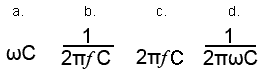
Calculate XcWhich formula from the following list would be used to calculate the reactance of a capacitor?
  • a)
  • b)
  • c)
  • d)

2.

Which of the following graphs illustrates the formula 2πƒ L ?Reactance graphs
  • a)
  • b)
  • c)
  • d)

3.

What is the reactance of a 0.01µF capacitor at a frequency of 1MHz?
  • a) 15.9Ω
  • b) 1MΩ
  • c) 62KΩ
  • d) 0.01Ω

4.

The effect of internal resistance in an inductor in a LR circuit is to: (Complete the sentence from the following choices)
  • a) Increase the phase difference between the inductor voltage and the supply current.
  • b) Increase the phase difference between the inductor voltage and the resistor voltage.
  • c) Decrease the phase difference between the inductor voltage and the supply current.
  • d) Decrease the phase difference between the supply voltage and the supply current

5.

Calculate XcCalculate the reactance of the capacitor in Fig 6.5.1.
  • a) 6.28Ω
  • b) 27Ω
  • c) 159Ω
  • d) 125Ω

6.

If the frequency of the supply in Fig 6.5.1 is doubled from the value shown, how will this affect XC?
  • a) It will rise slightly from its original value.
  • b) It will fall slightly from its original value.
  • c) It will rise to double its original value.
  • d) It will fall to half its original value.

7.

Calculate the approximate supply voltage needed to cause a current of 10mA to flow through a 15mH inductor at a supply frequency of 4kHz
  • a) 3.8V
  • b) 0.4V
  • c) 37.7V
  • d) 376mV

8.

What is the reactance of the inductor in Fig 6.5.2?Fig. 6.5.2
  • a) 1.6Ω
  • b) 31.4Ω
  • c) 15.9Ω
  • d) 159Ω

9.

What will be the current flowing in Fig 6.5.2?
  • a) 628µA
  • b) 15.9mA
  • c) 6.28mA
  • d) 1.59mA

10.

What will be the current flowing in Fig 6.5.2 if the supply frequency is doubled and the supply frequency is halved?
  • a) It will be double its original value
  • b) It will remain the same
  • c) It will be half its original value
  • d) It will be four times its original value