background image

Learn about-


Boxtop


Revision 2.15

18th October 2011


Prefer paper?

pdf logo

Click to download this complete module in PDF format.

Valid XHTML 1.0 Transitional

Step by Step logo

Module 4.6

Module 4 Quiz

What you should know.

  • After studying Module 1, you should:
  • •Be able to describe transient events in DC circuits.
  • • Be able to describe transient voltage and current relationships in a simple LR, CR and resistive circuits.
  • • Be able to describe transient events in CR and LR combinations in DC circuits.
  • • Be able to calculate LR and CR time constants.


Try our quiz, based on the information you can find in Module 4. Hopefully it won't be too difficult. Submit your answers to see how well you did. If you got any answers wrong, you´ll be told where to find the right answer, so you can learn more about transient events before you have another try.

1.
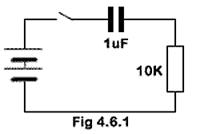
CR Circuit When the switch in Fig. 4.6.1 is closed, how long will it take for the capacitor voltage to reach its steady state value?
  • a) 1ms
  • b) 10ms
  • c) 50ms
  • d) 500us

2.

CR CircuitWhen the switch in Fig. 4.6.2 is closed, how long will it take for the capacitor voltage to rise to 6.3 volts?
  • a) 2.2ms
  • b) 220ms
  • c) 2.2s
  • d) 120ms

3.

A CR circuit connected to a DC supply will, for a time after a voltage is applied to it, behave as though the capacitors were very ________ value resistances, but these effects will disappear after a time approximately equal to _______ time constant(s). The missing words in this sentence are:
  • a) Low and one
  • b) Low and five
  • c) High and one
  • d) High and five

4.

LR Circuit Refer to Fig. 4.6.3: What will be the approximate voltage across the inductor 100ns after the switch is closed?
  • a) 6.3V
  • b) 7.07V
  • c) 0V
  • d) 10V

5.

Calculate the time constant of a circuit consisting of a 15mH inductor and a 470Kohm resistor.
  • a) 32ns
  • b) 7s
  • c) 31.9ms
  • d) 70ms

6.

If a simple LR circuit consisting of a 20Ω resistor in series with a 100mH inductor is connected to a 10V supply, from which it draws a current of 500mA after it has reached its steady state. How long after switch on, will the current take to reach 316mA?
  • a) 5ms
  • b) 2ms
  • c) 2s
  • d) 500ms

7.

An ideal circuit is a useful theoretical tool because:
  • a) It uses real components
  • b) It is drawn in a simplified format
  • c) It is designed to give optimum results
  • d) Real but unimportant factors can be ignored.

8.

In the formula I = E/(R+r) the quantity r is added to compensate for:
  • a) The internal resistance of the power supply.
  • b) The resistance of the switch contacts.
  • c) The delay caused by the switch closing and opening.
  • d) The tolerance rating of the resistor.

9.

The back EMF produced as an inductor charges up is proportional to:
  • a) The supply EMF
  • b) The charging current
  • c) The voltage across the inductor
  • d) The rate of change of the applied current

10.

The back e.m.f produced when an inductor is first connected to a DC supply is..
  • a) Proportional to the applied voltage
  • b) Inversely proportional to the value of inductance
  • c) Initially high, and then gradually reduces
  • d) Initially low, and then gradually increases