


Google Ads
Module 3.3
Practical Inductors

- After studying this section, you should be able to:
- • Apply the right hand grip (or curl) rule for a solenoid.
- • Describe typical applications for inductors
- • Recognise inductor schematic symbols.
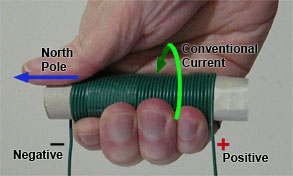
Fig. 3.3.1 The Right Hand Grip (or Curl) Rule.
The Right Hand Curl Rule for a Solenoid.
Many practical inductors are based on the solenoid. Because of its shape, the lines of magnetic flux are concentrated along the centre line of the coil and this produces a magnetic field with a north and a south pole. To find out which end of the solenoid is the north pole, imagine grasping the solenoid in the right hand as shown in Fig 3.3.1 with the fingers curled around the solenoid in the direction of CONVENTIONAL CURRENT FLOW, from positive to negative around the solenoid, the right thumb is laid along the side of the solenoid and will be pointing towards the solenoid´s north pole.
Practical Inductors.
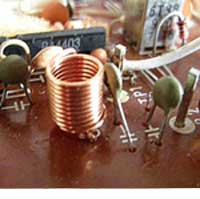
Fig. 3.3.2a. Air-Cored Inductors
Air-Cored Inductors
Simple air cored inductors are used in many circuits operating in the 1MHz to several hundred MHz range, including VHF FM radios and TV receivers.
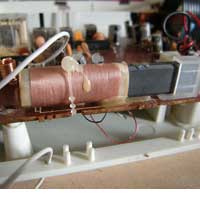
Fig. 3.3.2b. AM Radio Antennas
AM Radio Antennas
AM radio receivers use internal antennas that have a number of inductors wound around a ferrite rod. These are combined with fixed and variable capacitors to enable the radio to be tuned to the various station frequencies.
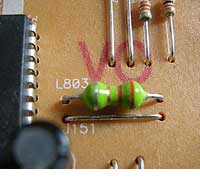
Fig. 3.3.2c. Colour Coded Inductors
Colour Coded Axial Lead-out Inductors
Looking very similar to resistors, colour coded inductors have typical values from 0.1µH to 1mH. The value given by the colour bands are given by a standard EIA 4 band code for commercial inductors, and by a Military Standard 5 band code for military types on which the first band is always silver (denoting a military component) and the fifth band has an extended range of tolerances to indicate close tolerance types of +/- 1% to 4%
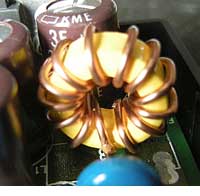
Fig. 3.3.2d. Toroidal Core Inductors
Toroidal Core Inductors
Toroidal (ring shaped) cores are very efficient at concentrating the magnetic flux within the coil and are often used for large current inductors and transformers, such as those used in power supplies.
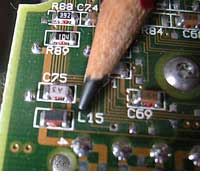
Fig.3.3.2e. Surface Mount Inductors
SMD Chip Inductors
Surface mounted multi-layer chip inductors are tiny; often only 3 or 4mm across. Although this physical size limits the values of inductance that can be achieved, typical values of less than 1nH up to a few hundred nH are useful for many radio frequency and communications applications. The example shown is part of a hard disk drive control circuit.
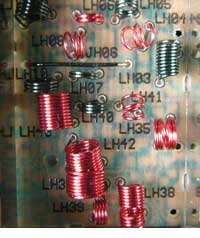
Fig.3.3.2f. Air Cored Inductors at UHF
Inductors at UHF
Air cored inductors for UHF applications may consist of only one or two turns of wire. In some cases even a straight-line conductor, a few millimetres long can have enough inductance to form a useful inductor or transformer. In these situations the exact positioning of inductors relative to other components or metal casing, such as screening cans, is vitally important. During construction individual inductances may have had their inductance fine-tuned by slightly altering their positions, or the spacing between turns.
Inductor Circuit Symbols
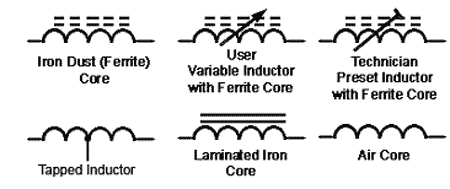
Fig. 3.3.3 Inductor (Schematic) Circuit Symbols.