Background image

Learn about-


Boxtop


Revision 2.15

18th October 2011


Prefer paper?

pdf logo

Click to download this complete module in PDF format.

Search with

Valid XHTML 1.0 Transitional

Maths Help

Want some help with electronics math? Download our helpful booklet with tips for buying and using a scientific calculator and for sorting out all those electronics values. Invaluable help for the questions at the end of this unit!

Maths Tips

Step by Step logo

Module 3.5

Inductors Quiz

What you should know.

  • After studying Module 3, you should:
  •   • Be able to describe electromagnetic effects in static conductors.
  •   • Be able to describe inductors, units of inductance and circuit symbols.
  •   • Be able to describe Self Induction and the effects of Back (counter) e.m.f. .
  •   • Be able to describe frequency effects in inductors.
  •   • Be able to describe constructional features and typical applications of inductors.

Try our quiz, based on the information you can find in Module 3. Hopefully it'll be a breeze. Submit your answers but don't be disappointed if you get answers wrong. Just follow the hints to find the right answer and learn about inductors as you go.

1.

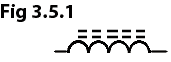
inductor What type of is inductor illustrated in Fig 3.5.1 ?
  • a) A laminated iron cored inductor.
  • b) A ferrite cored inductor.
  • c) A preset inductor.
  • d) An air cored inductor.

2.

The inductance of an inductor will be affected by which property or properties of the inductor's core?
  • a) The material of the core.
  • b) The material and size of the core.
  • c) The shape and size of the core.
  • d) The shape, size and material of the core.

3.

Which of the following ranges of inductance values would be most commonly encountered in electronic circuits?
  • a) henrys.
  • b) milli-henrys.
  • c) henrys and milli-henrys.
  • d) milli-henrys and micro-henrys.

4.

Which of the following properties of an inductor change with the applied frequency:
  • a) Reactance
  • b) Inductance
  • c) Reluctance
  • d) Resistance

5.

What is the value of the inductor shown in Fig 3.5.2?

inductor 4 band code
  • a) 27µH +/-10%
  • b) 2.7µH +/-20%
  • c) 270µH +/-10%
  • d) 27µH +/-5%

6.

Which of the following describes what happens to a non-moving conductor within a changing magnetic field?
  • a) The conductor will have a changing emf induced into it.
  • b) An emf will be induced into the conductor, proportional to conductor´s reactance.
  • c) The conductor will have a steady current induced into it.
  • d) A current will be induced into the conductor, inversely proportional to conductor´s reluctance.

7.

Which of the formulae shown in Fig 3.5.3 would be used for calculating back e.m.f. ?Fig-3-5-3
  • a)
  • b)
  • c)
  • d)

8.

Complete the following statement:
The magnetic field produced by a solenoid shaped inductor is:
  • a) Concentrated within, and along the axis of the coil.
  • b) Less likely to produce a back e.m.f. effect than in other coil shapes.
  • c) Most effective at very low frequencies.
  • d) More likely to produce a back e.m.f. effect

9.

When using the right hand curl rule for a solenoid, what do the fingers of the right hand indicate?
  • a) The direction of conventional current flow.
  • b) The direction of the solenoid´s north pole.
  • c) The direction of the solenoid´s south pole.
  • d) The negative terminal of the solenoid.

10.

What would be the value of back e.m.f induced at switch off, in a 3.3mH inductor passing a current of 250mA, assuming the time for the current to decay to zero was 50µs?
  • a) 10V
  • b) 16.5V
  • c) 22V
  • d) 32.7V