Background image

Learn about-


Boxtop


Revision 2.15

18th October 2011


Prefer paper?

pdf logo

Click to download this complete module in PDF format.

Search with

Valid XHTML 1.0 Transitional

Step by Step logo

Module 10.5

LCR Parallel Circuits Quiz

What you should know.

  • After studying Module 10, you should:
  • • Be able to recognise LCR parallel circuits and describe their action using phasor diagrams and appropriate equations.
  • • Be able to describe LCR parallel Circuits at resonance and the conditions for parallel resonance.
  • • Be able to carry out calculations on LCR parallel circuits, involving reactance, impedance, component and circuit voltages and current.
  • • Be able to describe current magnification, dynamic impedance and Q factor, and be able to calculate their values in LCR Parallel Circuits.


Try our quiz, based on the information you can find in Module 10. Submit your answers and see how many you get right. If you get answers wrong, just follow the hints on the answers page to find the right answer and learn about Parallel LCR circuits as you go.

1.
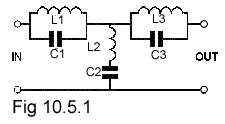
Fig 10.5.1With reference to Fig 10.5.1 the resonant frequency of the circuits L1/C1 and L3/C3 will be:
  • a) The same as L2/C2
  • b) Twice the frequency if L2/C2
  • c) Half the frequency of L2 /C2
  • d) Above and below the frequency of L2/C2

2.

In a parallel resonant circuit at resonance, the impedance is referred to as:
  • a) The equal reactance point and is at maximum.
  • b) The dynamic resistance and is at minimum.
  • c) The equal reactance point and is at minimum.
  • d) The dynamic resistance and is at maximum.

3.

What will be the approximate resonant frequency of a parallel LCR circuit containing L=1mH, C=1nF, R= 15Ω ?
  • a) 159kHz
  • b) 251kHz
  • c) 2.5MHz
  • d) 2.7kHz

4.

Fig 10.5.2 Phasor diagrams a-d show a single parallel resonant circuit operating at different frequencies. Which diagram shows the highest frequency?
  • a) Diagram a
  • b) Diagram b
  • c) Diagram c
  • d) Diagram d

5.

For a parallel LCR circuit at resonance, which of the following statements is true?
  • a) At resonance, XC and XL are equal.
  • b) The phasors IL and IC are in anti−phase.
  • c) The current flowing into the circuit at resonance is at maximum.
  • d) The impedance at resonance is at maximum.

6.

If the Q factor of a parallel resonant circuit is halved, what will be the effect on the bandwidth?
  • a) It will be halved.
  • b) It will not be changed.
  • c) It will double.
  • d) It will increase by four times.

7.

Fig 10.5.3Which of these formulae is correct for calculating the Q factor of a parallel resonant circuit?
  • a) Formula a
  • b) Formula b
  • c) Formula c
  • d) Formula d

8.

What words are missing from the following statement? The supply current phasor for IS in a parallel LCR phasor diagram at resonance will be _____________ amplitude.
  • a) Lagging IC by 90° and at its Maximum.
  • b) In phase with VS and at its Maximum.
  • c) In phase with VS and at its Minimum.
  • d) Leading IL by 90° and at its Minimum.

9.

Fig 10.5.4With reference to Fig 10.5.4 What quantity is represented by axis A?
  • a) Inductive Reactance.
  • b) Current.
  • c) Capacitive Reactance.
  • d) Impedance.

10.

What is the approximate Q factor of the circuit mentioned in Question 3?
  • a) 67
  • b) 81
  • c) 15
  • d) 32